The Fossil Didn't Change: How Fragmentary Fossils Get Passed Off as Complete Bones
It’s no secret that fossil skeletons are sometimes going for a lot of money these days. Any look at the headlines will have people scratching their heads and wondering, “Why don’t I get into this business?” There’s a gold-rush mentality in the dinosaur world at the moment, and like all gold rushes, it is attracting some less than scrupulous people.
Collectors and museums can shell out lots of cash for amazing displays, but they aren’t always getting what they think. There’s a clever trick that brokers and dealers are using to pump up their “Percent Complete” assessments (a topic that is fraught with fraud and misrepresentation on its own- see my article on the subject HERE) and drive up their prices. When prospective buyers see amazing osteographs full of colorful, filled-in bones, they stop asking questions and start looking for funding.
The most pervasive technique used is the “fragments are complete bones” trick. Here’s how it works.
Fossil skeletons always have fragments. Always. Sometimes, there are more fragments than complete bones and they must get pieced together. This isn’t bad or uncommon. Life was hard in the Mesozoic, and scavengers got to corpses back then just like they do today. A skeleton may have sat on a floodplain for months before getting buried, beaten by UV light and powerful weather before fossilization could even begin. After tens of millions of years in the ground, the skeleton starts weathering out again and may spend a long time going through freeze/thaw cycles, rain and erosion, or more before a fossil hunter finds it.
Skeletons get beat up by nature long before we find them. Fragments happen.
Fragments aren’t always bad, and many times they’re identifiable. A section of rib is pretty easy to spot. A vertebra has so many diagnostic parts on it that, even if it’s busted into twenty pieces, you can still tell if the fragment is a section of centra or a pair of prezygopophyses. Don’t let the anatomical terms scare you. Bones have identifiable shapes and puzzles can get reassembled.
The problem happens when a single, small fragment gets passed off as an entire bone. For example, pretend that you’ve got a nice tyrannosaurid skeleton. You’ve got several good bones from it, and a small truckload of fragments. One of those fragments is easily identified as a piece of a dorsal rib (from the main body section). You know what a rib looks like because you’ve worked on other tyrannosaurs before, so you can sculpt the rest of it or use a cast rib to fill in the gaps. If you are honest about what you have found, you would know that your original material is represented like this:
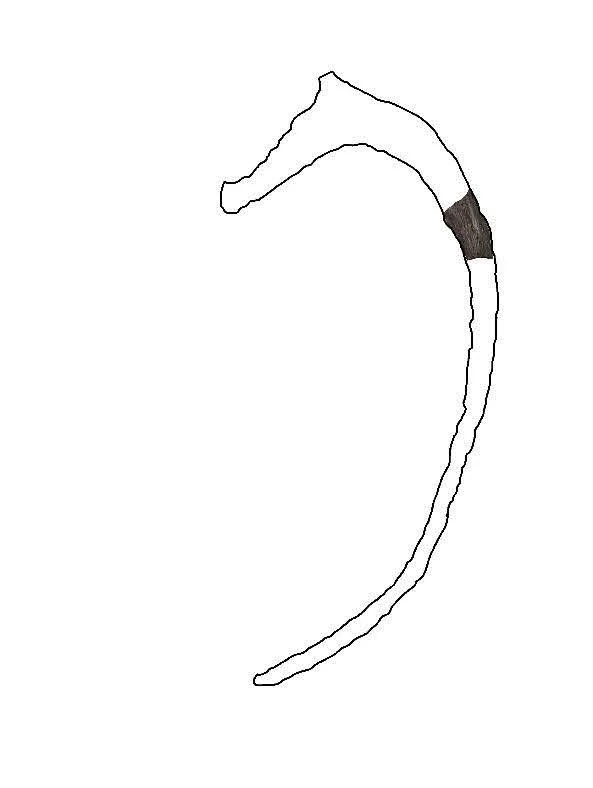
The nice, identifiable little rib fragment has found a home! When you draw your osteograph, you traditionally color it in instead of using a photo and represent it like this:
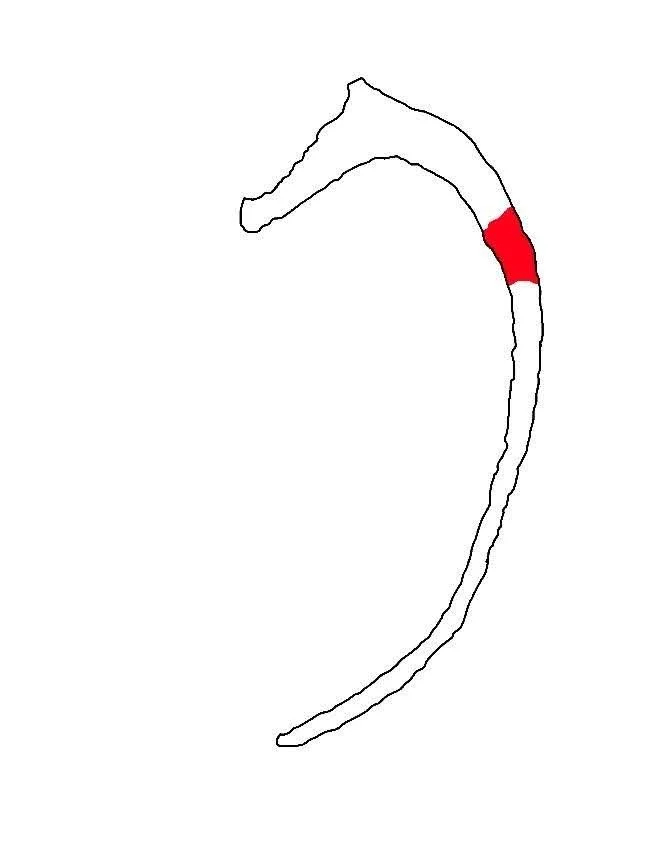
This looks great! The bone fragment makes sense, it is placed well, and you have communicated to your audience what was actually found out there in the badlands.
When someone wants to make the rib appear even better, they just fill the whole thing in:
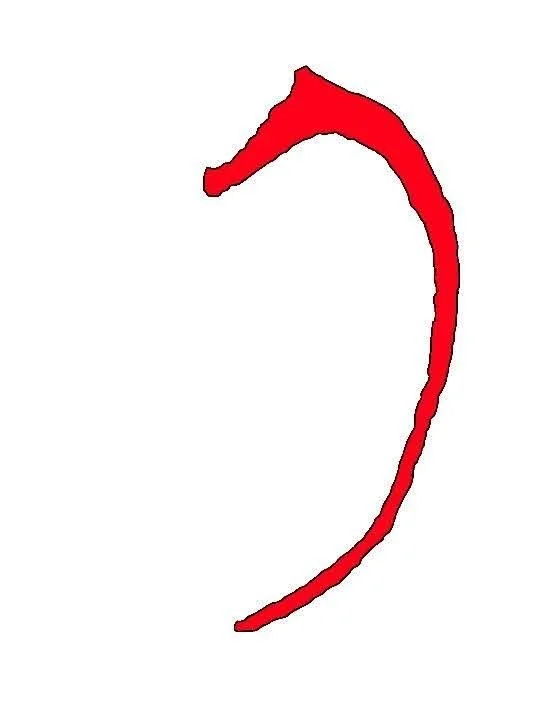
Do you see how easy that was? With nothing more than the mysterious magic of the Paint Bucket tool in photoshop, I transfigured that rib fragment into a complete bone. How would an inexperienced collector know the difference? How would a struggling museum director who doesn’t have an vertebrate paleontologist on staff get a solid idea of what they’re looking at? As a dealer, the difference isn’t really my problem once the check clears. Caveat emptor.
I don’t think it is too much of a stretch to say that one of these representations is honest and the other is not. Multiply this by hundreds of fragments and an entire skeleton and the problem just compounds.
Let’s look at another example from a fossil in my collection right now. At Triebold Paleontology, Inc., we have a Tyrannosaurus rex skeleton. It was found in an ancient flood plain and we moved a lot of rock to get it. The bones themselves are in great shape, with excellent surface material and preservation. The only issue is that it came in thousands of pieces and we have been reassembling them for several years now.
If I’m honest about what is preserved of this skull, my image looks like this:
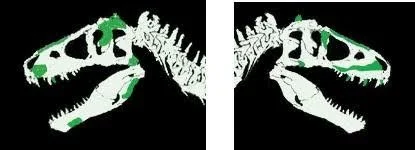
The left side of the skull has a fragment of maxilla, a piece of dentary, some of the quadratojugal, etc. The right side has an incomplete maxilla, a piece of jugal, and an incomplete lacrimal. These are great bones, we know what they are, and they help us make a proper reconstruction.
If I’m using the dishonest method, the skull diagram looks like this:
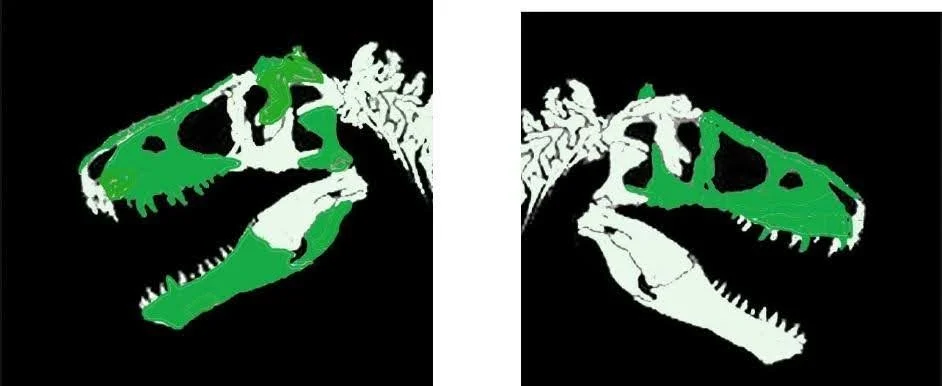
Wow.
That little piece of the lower jaw sure looks a lot better in this picture. Remember, nothing has changed about the real fossil. I have merely sculpted or poured a cast part, incorporated the original material into it, and then colored in all of the replica material and told you that it counts as a complete bone.
This is unconscionable. It is blatant misrepresentation and it happens all the time.
How do you protect yourself?
Buy a UV flashlight. Spend a little bit of money and get one that at least puts out strong UVA. If you are willing to save your pennies for a little while, you can get one that pumps out UVB and UVC as well. Get some polarized sunglasses to protect your eyes and then start shining that thing on every fossil reconstruction you come across. It isn’t a foolproof method, but it will catch a lot.
Ask the dealer if they have CT scans. That is still a little out of reach for most people, but it is a practice that is becoming more common and will continue to do so. Anyone charging eight figures for a skeleton should be able to produce that if they are serious.
Read everything you can, watch documentaries, and visit museums. Education and experience are powerful. Ask to tour the lab and the workshop.
Find a trusted advisor who does not have a financial stake in your acquisition. Brokers are charming people, and I’m sure you are good friends with the one you’re talking to.
He would certainly never misrepresent something to you, right? However, in what other transaction does a million dollar payday not change the behavior of people? Call someone else, make friends with a scientist, and talk to someone who isn’t seeing dollar signs.
Finally, if someone hands you a diagram with bones colored in and there are no fragmentary bones represented, they are absolutely using the dishonest method. No skeleton is complete and there are always blemishes or fragments. If it looks too good to be true, it is.
Using fragments in a skeletal mount is fine. It is a regular practice and should continue so that more people get to see more original material. The issue is honesty. No one should profit off of a lie. No one should take advantage of someone else’s inexperience.
Take your time. Ask lots of questions. Kick the tires and protect yourself.